Picture the scene. It is a Sunday afternoon somewhere in the Cheshire countryside, maybe a pub lunch near Tarporley or a family gathering in one of those beautiful villages between Northwich and Nantwich where the black and white houses line the road and everything feels slightly timeless. There is good food on the table, conversation is flowing, and then someone passes the bread basket and you quietly, automatically, without even thinking about it, pass it along without taking any.
Not because you are not hungry. Because eating a crusty bread roll with the teeth you currently have is something you gave up on a while ago.
This is not a dramatic story. It is not even a particularly unusual one. Hundreds of thousands of adults across the UK live with some version of this quiet, daily accommodation to the limitations of their teeth, and most of them have been managing it for so long that it has simply become normal. The bread roll. The apple you cut into pieces. The corn on the cob at the summer barbecue that you watch everyone else eat while you find something softer.
If you are reading this from somewhere in Cheshire, whether that is Northwich or Winsford, Crewe or Congleton, Macclesfield or the leafy streets of Wilmslow, the chances are this resonates. And the chances are equally good that at some point you have asked yourself the question this post is going to answer properly: is there actually a meaningful difference between dentures and dental implants, and which one is genuinely right for me?
The honest answer requires a proper comparison, not a sales pitch for one option over the other. So here it is.
What we are actually comparing
Before we get into the details, it is worth being clear about what we are comparing.
When we talk about full arch implants, we are talking about a procedure that uses four to six titanium implants placed into the jawbone to support a complete fixed arch of teeth. The teeth are permanently secured and do not come out. The most commonly used technique is sometimes called All-on-4, which refers to the specific approach of using four strategically angled implants to support the full arch, though the number of implants used can vary. Smile-in-a-Day is another way the same concept is described when the fixed teeth are placed on the same day as the implants.
When we talk about dentures, we are talking about a removable appliance that sits on the gum tissue and replaces either a full arch or a partial set of missing teeth. Modern dentures are significantly better than the appliances of a generation ago, and a well-made, well-fitted denture is a legitimate tooth replacement option for many patients.
These are both real, clinically valid approaches to replacing a full arch of missing or failing teeth. They have meaningfully different implications for daily life, long-term oral health, and cost. The right choice depends entirely on the individual.
Are full arch implants better than dentures?
Full arch implants are fixed in place, offer stronger biting force, and prevent the bone loss associated with long-term denture wear. Dentures remain a reasonable option for some patients, particularly where budget or bone volume rules out implants, but implants generally give better function and stability.
The everyday Experience
This is where the comparison matters most for most people, so let’s start here rather than burying it at the end.
Life with full arch implants
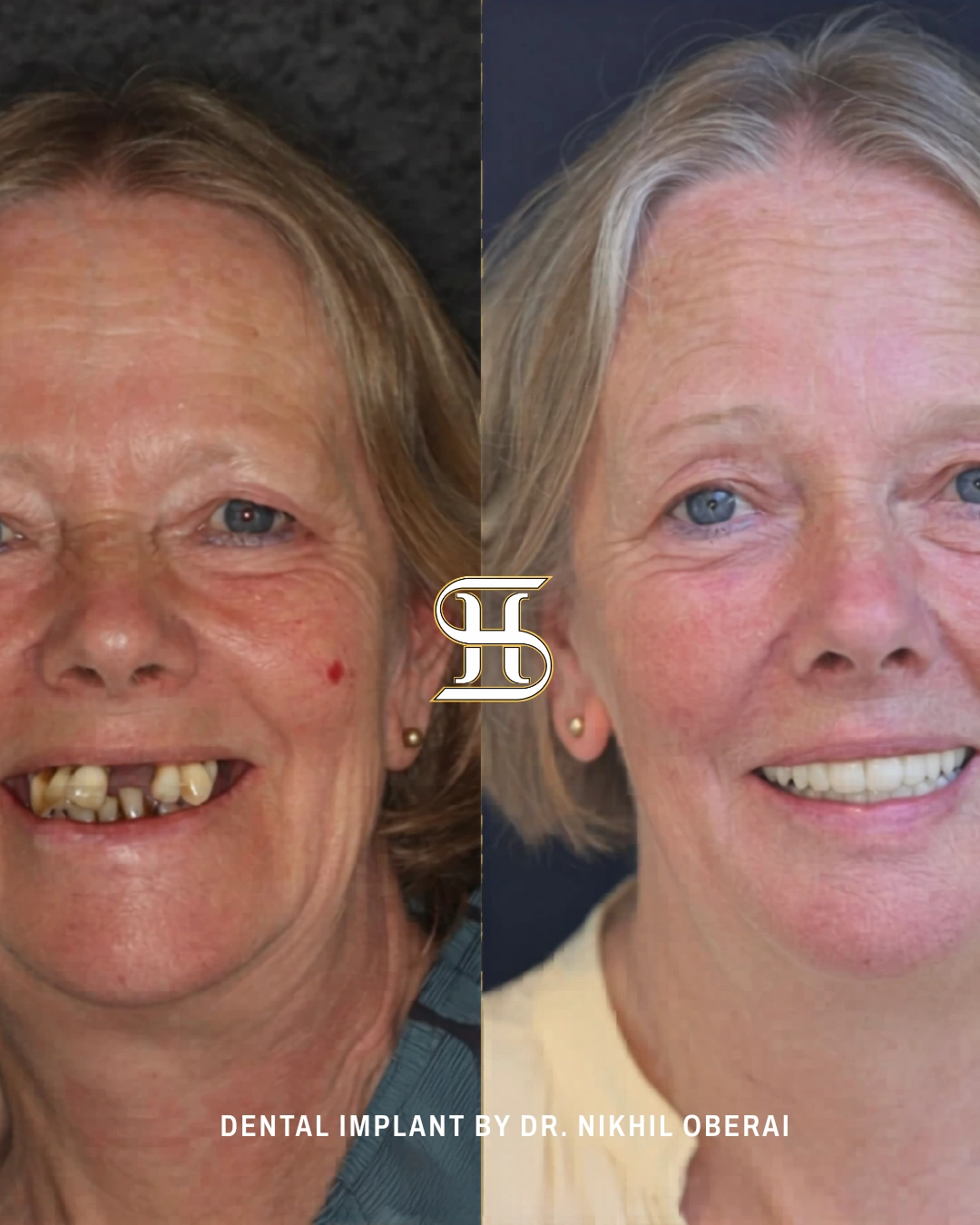
The day-to-day experience of living with full arch implants is, for most patients, indistinguishable from the experience of having your own natural teeth. The teeth do not move. They do not need to come out at night. They are brushed and flossed in place exactly as natural teeth are. You eat whatever you want, whenever you want, without a moment’s thought about whether your teeth are going to let you down.
Patients who have made the transition from dentures to full arch implants consistently describe the same experience: they stop thinking about their teeth. Not because anything dramatic has happened, but because the constant low-level awareness that comes with wearing a removable appliance, that awareness of where it is, whether it has shifted slightly, whether it is secure, whether the person across the table has noticed anything, simply disappears.
The bread basket gets taken. The apple gets eaten. The corn on the cob at the barbecue is just lunch again.
Life with dentures
A well-made modern denture, fitted properly and maintained correctly, can be genuinely functional. This is worth saying clearly, because the narrative around dentures is often unnecessarily negative, and for patients who are not suitable for implants or who are not ready to pursue them, a good denture is a perfectly reasonable solution.
The honest account, however, is that most long-term denture wearers will tell you that the experience requires ongoing management. Lower dentures are particularly challenging because they rely on the shape of the gum ridges rather than suction for retention, and as the bone beneath them changes shape over time, the fit progressively deteriorates. Many patients use adhesive to compensate, which helps but does not fully solve the problem.
The foods that are difficult on dentures, crusty bread, raw apples, corn on the cob, chewy or fibrous foods generally, are a genuine and daily limitation. The social awareness, the slight hesitation before laughing too broadly or speaking too quickly, the adjustment of how you hold yourself in certain situations, accumulates into something that is hard to quantify but impossible to ignore once it is pointed out.
And then there is the routine of removal. Taking teeth out at night is, for most people who do it, something they simply accommodate. But it is worth acknowledging that it never completely feels like nothing.
Do full arch implants feel more natural than dentures?
Yes, because they’re permanently fixed to the jaw, full arch implants function and feel much closer to natural teeth than removable dentures. Patients typically describe being able to bite and chew with confidence again, often within weeks of the final restoration being fitted.
The clinical differences that matter long-term
Beyond the day-to-day experience, there are clinical differences between implants and dentures that have real long-term consequences for your oral health and the structure of your face.
Bone loss
This is the most significant clinical difference and the one that is least well understood by most patients.
When a tooth is lost, the bone that surrounded the root begins to resorb. It is a gradual process, but it is continuous, and it is driven by the absence of mechanical stimulation that a root used to provide. The same process affects the jawbone when all teeth are lost or removed. It continues throughout life and it cannot be reversed.
A denture sits on top of the gum tissue. It does not go into the bone. It does not stimulate it. It does not halt the resorption in any meaningful way. In fact, there is evidence that the pressure of a denture bearing down on the gum ridge may actually accelerate the bone loss beneath it over time.
This has practical consequences that compound year after year. A denture that fitted well when it was first made becomes progressively looser as the bone beneath it changes shape. The face changes shape too: the lower third shrinks, the chin moves closer to the nose, the cheeks become less supported. If you have ever seen the characteristic look of someone who has worn dentures for twenty or thirty years, the way the face folds in on itself slightly, that is bone loss.
An implant goes into the bone. The titanium post functions as an artificial root and transmits mechanical force through the bone when you bite and chew, which is exactly the stimulus the bone needs to maintain its volume. Implants do not just replace teeth; they preserve the jaw structure that supports the face. For patients who are concerned not just about function but about how they will look in ten, fifteen, twenty years, this is one of the most compelling arguments for implants.
Fit and stability over time
Because dentures rely on the shape of the gum ridges for retention, and because those ridges change shape as the bone beneath them resorbs, the fit of a denture is a moving target. It typically needs relining after a year or two of wear and may need replacing every five to ten years as the jaw continues to change.
A well-placed implant, in contrast, is stable for life. The implant itself does not change. The bone around it is maintained rather than lost. The prosthesis on top may eventually need attention after many years, but the foundation beneath it stays where it was placed.
Adjacent teeth and gum health
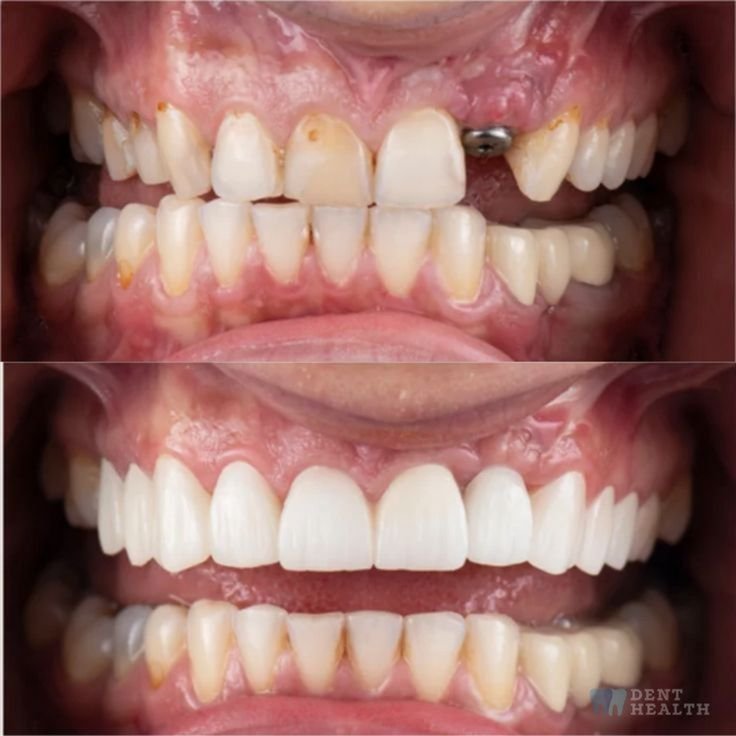
For patients who have some natural teeth remaining, a partial denture uses clasps around the neighbouring teeth for retention. Over time, the forces these clasps place on the supporting teeth can cause damage. An implant replaces a missing tooth without affecting the adjacent teeth at all.
The cost comparison and why it is more complicated than it looks
The upfront cost difference between dentures and full arch implants is significant. A well-made full denture costs somewhere in the hundreds of pounds. A full arch implant package at Heritage Smile Group starts from £11,500 for a single arch. That difference is real and it would be dishonest to pretend otherwise.
But the comparison deserves a longer-term frame, because the upfront figures do not tell the whole story.
A denture is not a one-time investment. It needs professional relining as the fit changes, typically every one to two years. It may need repairing if it breaks. It will need replacing every five to ten years as the jaw continues to change beneath it. Dentine adhesive, specialist cleaning products, and replacement parts all add up over decades of use.
A full arch implant package, properly placed and maintained, is designed to be a permanent investment. The implants themselves do not typically need replacing. The prosthesis on top, the actual teeth, may need attention after many years, but the surgical foundation is a one-time cost. When you spread the implant cost across a twenty or thirty year horizon and account for the cumulative cost of denture management over the same period, the gap narrows considerably.
There is also the question of the consequences of bone loss, which has a cost of its own. Patients who have worn dentures for many years and eventually decide to pursue implants find themselves in a more complex clinical situation than if they had chosen implants earlier. More bone has been lost, which may require bone grafting as an additional procedure before implants can be placed. The clinical pathway is longer and more involved than it would have been a decade earlier, which means the eventual cost is higher too.
Full details, including current pricing and finance options, are set out on our dental fees in Cheshire page, alongside dental finance and payment options for patients who want to spread the cost, which means the monthly payment for full arch treatment is often more comparable to other regular expenditures than the upfront figure suggests. It is worth having that conversation at your consultation before the cost alone decides the outcome.
How much do full arch (All-on-4) implants cost compared to dentures?
All-on-4 implants cost more upfront than dentures but typically last decades longer, which makes them more cost-effective over the long term for many patients. Dentures usually need relining or replacing every five to eight years, while implants are designed for lasting stability with routine care.
Who is full arch implants for and who is dentures for?
This is a practical question, and it deserves a practical answer.
Full arch implants tend to be the right choice for patients who:
Have been wearing dentures and are frustrated by the instability, the dietary restrictions, or the daily management. Are missing all or most of their teeth and want a permanent, fixed solution that they will not have to think about. Are concerned about the long-term changes to the jaw and face that bone loss produces. Are prepared to make a larger upfront investment in exchange for a solution that is designed to last a lifetime. Are in reasonably good general health and have sufficient bone for implant placement, or are prepared to undergo the additional procedures needed to create sufficient bone.
Dentures tend to be the right choice for patients who:
Are not suitable for implants due to specific medical factors or insufficient bone that cannot be addressed with grafting. Are not yet ready to pursue implants and want a solution that can be placed more quickly and at lower upfront cost. Have financial constraints that make implants genuinely inaccessible even with finance options. Are managing partial tooth loss and want a removable solution that can be adapted if further teeth are lost.
Every mouth is different, and the honest answer is that neither option is universally better. Someone managing well with dentures and happy with the day-to-day trade-offs may have no reason to change. For someone tired of adhesive, sore spots and a shrinking list of foods they can eat comfortably, full arch dental implants (All-on-4) in Cheshire are worth a proper conversation, alongside the wider range of dental implants in Cheshire we offer for patients missing one tooth or several.
What matters is making the choice with a full understanding of what each option involves long-term, rather than choosing a denture because it is what you were offered or choosing implants because they sound more impressive without understanding the clinical commitment involved.
Implant stabilised dentures, the option that sits between the two
It is worth mentioning a third option that falls between a conventional denture and a fully fixed implant arch, because it is one of the most popular treatments at both our Wilmslow and Northwich practices and genuinely changes the experience for a lot of patients.
Implant stabilised dentures use two to four implants placed into the jawbone, with special attachment clips fitted to the underside of the denture. The denture snaps onto the implants and stays firmly in place during the day. It still comes out for cleaning at night, but during the day it does not move, does not require adhesive, and provides a level of stability and confidence in eating and speaking that a conventional denture cannot match.
For patients who are hesitant about the commitment or cost of a fully fixed arch but who are frustrated with the instability of a conventional denture, implant stabilisation is often the step that transforms their daily experience without requiring the larger investment. Two implants in the lower jaw, which is where most denture stability problems originate, can make a remarkable difference.
The bone preservation benefit is partial, because the denture still covers the gum tissue and the bone beneath areas not covered by implants continues to resorb. But the stability and functional improvement is significant, and for many patients it represents exactly the right balance between what they need and what they are ready to commit to.
If you’re weighing up full arch implants against dentures, whether you’re coming from Northwich, Wilmslow or one of the surrounding villages, book a consultation with Heritage Smile Group and get a straight answer on which option genuinely fits your mouth, your budget and your life.