James had the presentation open on his laptop and a coffee going cold beside it when his colleague leaned over and asked, only half joking, whether he’d finally caved and got braces. He hadn’t. What he’d actually done was start Invisalign three weeks earlier, and nobody in the Wilmslow office had noticed until he mentioned it himself. That’s usually the first thing adults want to know when they’re weighing up Invisalign vs braces: will anyone actually be able to tell.
It’s a fair question, and not the only one. Cost, treatment time, comfort and how each option fits around a working week all matter just as much once you’re past school age and straightening your teeth becomes something you’re paying for yourself, on your own schedule. At Heritage Smile Group in Wilmslow, this comparison comes up in consultations most weeks, and the honest answer depends less on which treatment is “better” and more on which one suits how you actually live.
What’s the Real Difference Between Invisalign and Braces?
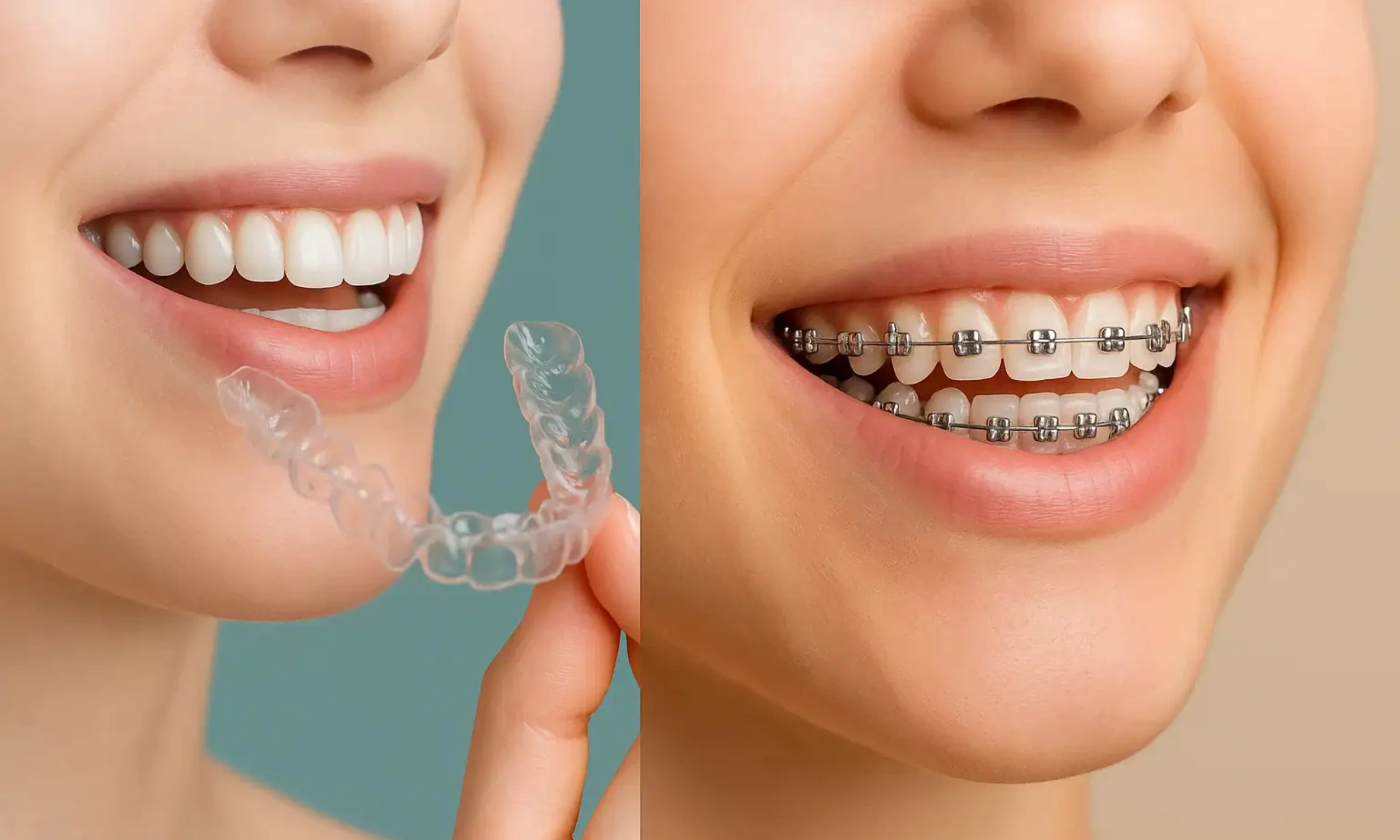
Traditional braces use fixed metal or ceramic brackets, wired together and adjusted in the chair every few weeks. Invisalign uses a series of clear, removable aligners, each one nudging your teeth slightly closer to their final position before you swap to the next in the set.
The mechanics matter less than the day-to-day experience, though. Braces stay on your teeth around the clock and can’t be taken out for meals, cleaning or photos. Invisalign comes out for eating and brushing, which changes quite a lot about how a working adult manages the routine.
Is Invisalign as Effective as Braces?
For straightforward cases, mild crowding, small gaps or a bite that’s slightly out of alignment, the two approaches tend to land in similar places by the end of treatment. Where braces still hold an edge is with more complex movements, particularly cases involving significant rotation or bite correction that needs constant, unremovable force.
A consultation is really the only reliable way to know which category your teeth fall into, since photos and online quizzes can’t account for what an X-ray and a physical exam will show.
There’s also the question of treatment time, which tends to surprise people either way. Mild to moderate adult cases with Invisalign often wrap up somewhere between six months and a year, while braces for a similar case might run slightly longer simply because adjustments happen less frequently and rely on the wire doing steady, gradual work between appointments. Neither timeline is fixed until your dentist has actually mapped out your specific movement plan, so treat any number you hear before a consultation as a rough guide rather than a promise.
Is Invisalign as effective as braces for adults?
For most mild-to-moderate cases, Invisalign achieves comparable results to traditional braces. More complex bite issues, however, may still respond better to fixed braces, which is why a proper assessment at the start matters more than the marketing on either side.
Cost: Is Invisalign More Expensive Than Braces?
This is the question that comes up almost every time, usually somewhere around the second or third sentence of the conversation. In reality, the price gap between Invisalign and braces has narrowed considerably over the past few years, and for many adult cases the two sit close enough together that cost alone rarely settles the decision.
Full details, including how payment plans work, are set out on the Invisalign fees in Cheshire page, which is worth a read before your first appointment so there are no surprises once a treatment plan is on the table.
Is Invisalign more expensive than braces?
Pricing between Invisalign and braces is broadly similar for most adult cases in Cheshire. The right choice tends to come down to case complexity and how much you value discretion and convenience, rather than cost being the deciding factor on its own.
Comfort and Lifestyle: Which Fits Around a Working Week?
For a lot of adults in Wilmslow, Alderley Edge and Prestbury, this is where the decision actually gets made. Braces mean regular tightening appointments, some soreness after each adjustment, and permanent brackets that show up in every video call and school gate conversation. Invisalign trays cause mild pressure for the first day or two of each new aligner, then settle, and they come out for the meetings, meals and photos where you’d rather they weren’t there.
The trade-off is discipline. Aligners only work if you’re wearing them for around 20 to 22 hours a day, which means genuinely committing to popping them back in after lunch rather than leaving them in a drawer at the office. Braces, by contrast, need no daily decision-making at all because there isn’t one to make.
Cleaning is another everyday difference worth weighing up. Brushing and flossing with fixed braces means working carefully around brackets and wires, often with extra tools like interdental brushes to reach food trapped underneath. Invisalign trays come out entirely, so you brush and floss exactly as you did before, then rinse the aligner before it goes back in. For anyone driving into Wilmslow from Handforth or Knutsford after a long day, that simplicity tends to matter more than it sounds like it would on paper.
Is Invisalign less noticeable than braces?
Yes, clear aligners are far less visible than metal braces, which is one of the main reasons working adults in Cheshire choose Invisalign. Many colleagues and friends won’t notice treatment is happening at all unless they’re told directly.
Can adults wear Invisalign at any age?
Yes, there’s no upper age limit for Invisalign, provided your teeth and gums are healthy enough to move safely. Many adults start treatment in their 40s, 50s and beyond, often after years of putting it off, with the same suitability checks applied regardless of age.
So, Which Should You Choose?
If discretion during a busy working week matters to you, and you’re confident you’ll wear your trays consistently, Invisalign is usually the more comfortable path. If your case involves more complex movement, or you’d rather not think about compliance at all, braces remain a dependable, proven route to the same destination.
Either way, the decision starts with an honest look at your teeth rather than a preference decided in advance. The team at the Croft Dental & Implant Practice in Wilmslow can talk through both options properly, and you can browse the full range of clear aligner treatments on the Invisalign in Cheshire hub page before you come in.
If you’ve been putting off straightening your teeth because you didn’t fancy metal brackets through your 30s or 40s, get in touch with Heritage Smile Group in Wilmslow and find out which option, Invisalign or braces, actually fits the life you’re living now.